
Events
Explain how events and registrations represent student engagement in Slate, locate event activity associated with a student, and use event information to better understand and support the student's admissions journey.
Events help counselors understand how students are engaging with the institution—not just whether they submitted an application.
Events: Seeing Student Engagement
Admissions counseling is about more than applications. Students interact with your institution in many ways before making an enrollment decision.
They may attend a campus tour, register for an open house, join a virtual information session, attend an admitted student event, participate in a counselor appointment, or register for another recruitment activity.
Slate Events can help organize these experiences and track student registrations and participation.
For counselors, event information provides valuable context. It can help answer questions such as: Has this student visited campus? What events have they registered for? Did they attend? What type of engagement have they had with our institution?
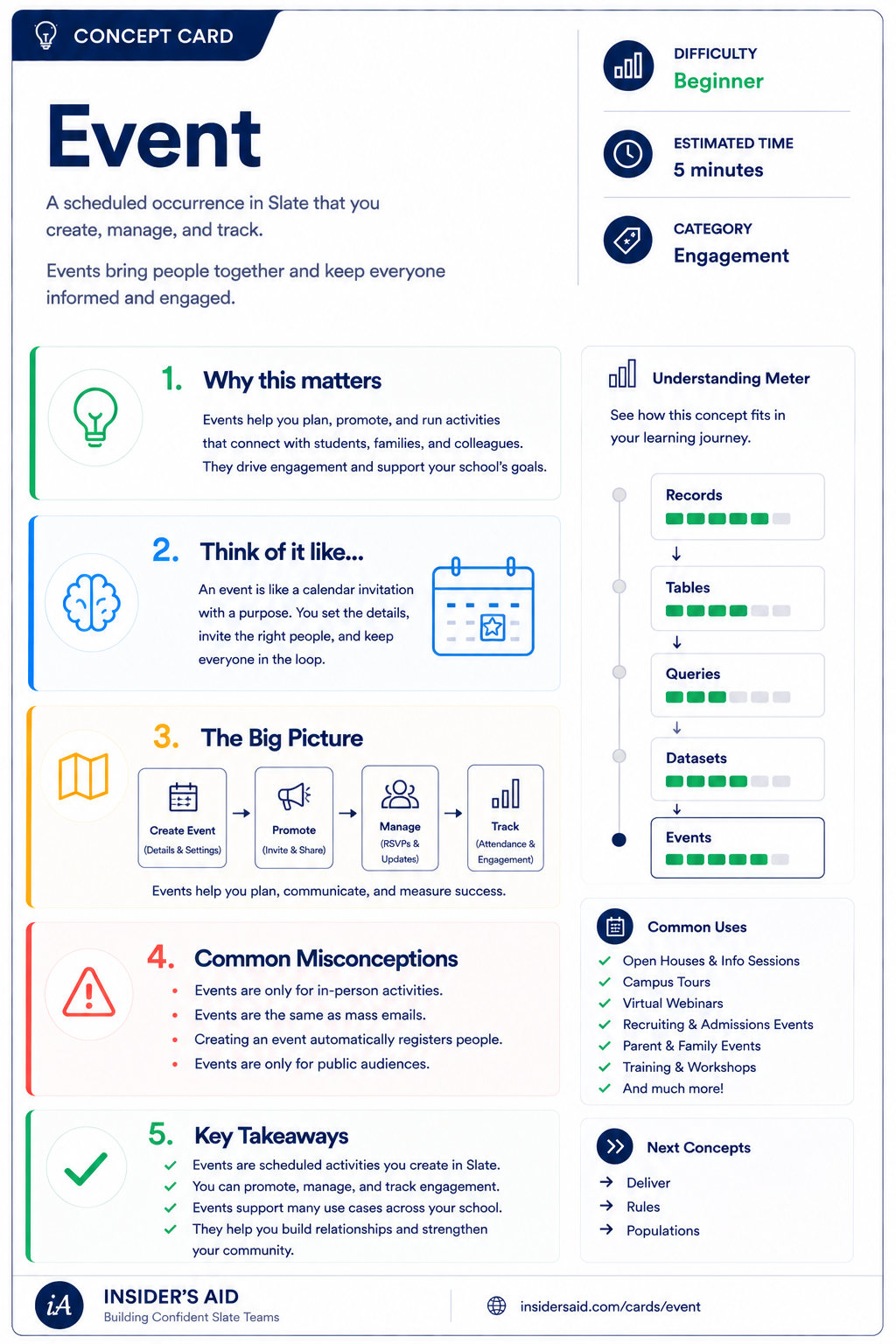
Event
A scheduled occurrence you create, promote, manage, and track to keep people engaged.
Event → Registration → Engagement
An opportunity or experience offered by the institution
A person's connection to that event
Information counselors can use to better understand the student's journey
Event
Registration
Engagement
For example — Campus Tour → Jordan Smith registered → Jordan has already engaged with the institution through a campus visit.
Events provide context. A student's event history can help you understand where they may be in their exploration and what kind of follow-up may be most helpful.
Remember these
A scheduled experience or activity managed through Slate.
A person's connection to an event.
The record of event interactions associated with a person.
How a student has interacted with the institution through activities such as visits, programs, or events.
Check your understanding
One question at a time. Wrong answers are just practice.
Why might event information be useful to an admissions counselor?
Explore a Student's Event Activity
Locate event-related activity and use it to better understand a student.
Open your institution's Slate database in another tab. Locate a Person record you are permitted to view, and look for event-related activity associated with that person. Depending on your institution's configuration, this information may appear in different areas of the record.
- One event the student registered for
- The event date
- The event type or name
- Whether attendance or participation information is available
- Any other event-related information visible to you
What does this event history tell you about the student? Use this reflection prompt: “This student has engaged with our institution by __________.”
This student has engaged with our institution by attending a campus tour and registering for an admitted student event.
Event information can appear differently depending on your institution's configuration, permissions, and views. Focus on identifying the student's connection to an event rather than finding an identical screen.
Slate is highly customizable. Your institution's tabs, fields, views, permissions, and processes may differ from examples used throughout Insider's Aid. Focus on understanding the concept rather than finding an identical screen.
Reflection
A student has registered for an upcoming campus tour. What can you reasonably conclude?
A Student Calls About Their Visit
A student calls and says: “I registered for a campus visit, but I can't remember the date.” What is the best first step?
What is the best first step?
Prepare for Your Conversation
You're preparing to call a prospective student. You notice they have already attended a campus tour and registered for an upcoming open house. How should that information influence your conversation?
How should that information influence your conversation?
Engagement Is Context, Not Certainty
A student has attended several events. What is the safest interpretation?
What is the safest interpretation?
Think Like a Slate Counselor
Find the student
Look at their engagement
Understand the context
Personalize your next interaction
When you work with a student, don't look only at their application status. Ask: How have they already interacted with us?
Event history can help you understand the student's journey and make your outreach more informed.
Use event history as context—not as a conclusion. A visit or registration can tell you that a student has engaged, but it does not automatically tell you what they will do next.
Put It Together
The Counselor pathway now builds this role-specific mental model: Find → Understand → Collect → Engage.
Start with the right student.
Understand the information stored about them.
Recognize how new information may be collected.
Understand how the student has interacted with your institution.
An integrated example: PERSON RECORD → FIELD: Email Address → FORM: Campus Visit Registration → EVENT: Campus Tour → REGISTRATION: Student registered for September 10 → COUNSELOR CONTEXT: “This student has already visited campus.”
The more pieces you understand, the more useful the Person record becomes. You're no longer just finding a student. You're beginning to understand their journey.
What Happens When the Student Responds?
Students don't only engage through events. They also reply to emails, send questions, and respond to communications.
Those responses need somewhere to go.
That's where Inbox comes in.
Keep Learning
Event
A scheduled occurrence you create, promote, manage, and track to keep people engaged.
Records
Review the starting point for understanding a student.
Forms
Review how students can register or provide information.
Inbox
Learn how student responses can be managed.
Fields
Review the information stored about a person.
Finished the lesson?
Mark it complete to track your progress. Progress is saved in this browser.
Inbox
Understand how student responses and communications can be managed through the Slate Inbox.