
Datasets
Explain what a dataset is, recognize how datasets organize structured records and information, distinguish a dataset from a query, explore the structure of a dataset, and identify situations where a dataset may be appropriate.
Datasets organize reusable collections of structured records and information. They are not simply saved query results.
Datasets: Organizing Structured Information
So far, you've learned how Slate stores information on records, how forms can collect information, and how queries can find records that match specific criteria.
But sometimes an institution needs to maintain a structured collection of information that is not simply the result of a query. That's where datasets come in.
A dataset is a structured collection of records that can be used to organize and maintain reusable information inside Slate. Examples might include academic programs, staff members, scholarships, territories, institutional contacts, or other reference and operational information.
Some datasets are delivered by Slate. Institutions can also create custom datasets for their own needs.
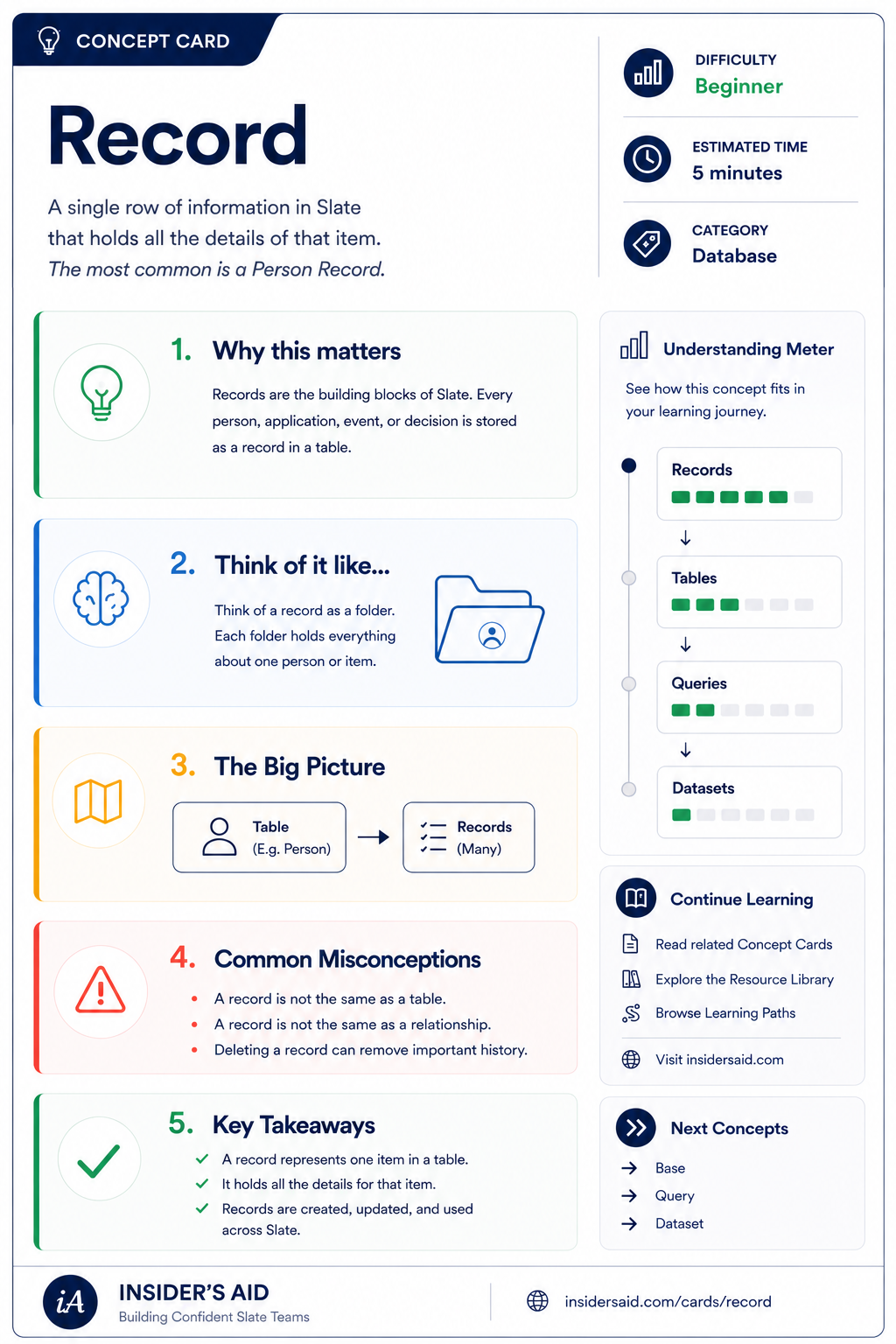
Record
A single row of information in Slate that holds all the details of that item — most often a person.
Dataset → Records → Tabs → Information
The overall collection
The individual items in the collection
Ways information can be organized within a record
The details stored about each record
Dataset
Records
Tabs / Sections
Fields / Information
For example — DATASET: Academic Programs → RECORD: Nursing → INFORMATION: Campus, Program Code, Credential, Active Status.
Think of a dataset as a structured home for a type of information your institution needs to maintain and reuse.
Remember these
A structured collection of related records and information.
An individual item within a dataset.
A way information within a dataset record may be organized.
A defined place where a specific piece of information is stored.
A dataset created by an institution to organize information for its own processes.
Dataset vs. Query
Finds records that match criteria.
- “Find everyone whose Academic Interest = Nursing.”
Maintains a structured collection of records and information.
- “Maintain the institution's list of academic programs, including program name, campus, credential, code, and active status.”
A query finds. A dataset organizes and maintains. Datasets are not simply saved query results.
Check your understanding
One question at a time. Wrong answers are just practice.
Which statement best describes a dataset?
Explore a Dataset
Identify the structure of a dataset and the information stored within its records.
Open your institution's Slate database in another tab. Locate a dataset you are permitted to view — this may be a Slate-delivered dataset or a custom dataset created by your institution. Open one record within the dataset and explore its structure.
- Identify the name of the dataset
- Identify one record within the dataset
- Look for tabs, sections, or areas organizing information
- Identify at least three pieces of information stored on the record
- Think about why your institution might need this information in a structured collection
Can you explain the structure? Use this mental template: “This dataset organizes __________. Each record represents __________ and stores information such as __________.”
This dataset organizes academic programs. Each record represents one program and stores information such as campus, credential, program code, and active status.
Slate is highly customizable. Your institution's tabs, fields, views, permissions, and processes may differ from examples used throughout Insider's Aid. Focus on understanding the concept rather than finding an identical screen.
Reflection
A dataset called “Academic Programs” contains separate records for Nursing, Cybersecurity, and Business. Which statement is correct?
Where Should This Information Live?
Your institution needs to maintain a current list of academic programs. For each program, staff need to store Program Name, Campus, Program Code, Credential Type, and Active Status. The information needs to be reused in forms, processes, and reporting. Which Slate tool would you most likely investigate?
Which Slate tool would you most likely investigate?
Find It or Maintain It?
Your director asks: “Can you give me a list of everyone interested in Nursing?” What are you primarily trying to do?
What are you primarily trying to do?
Choose the Right Tool
Which situation most naturally suggests a dataset?
Pick the situation that most naturally suggests a dataset.
Think Like a Slate User
Do I need to find records?
Start with the problem you're solving
Yes
Query
“Which records match my criteria?”
Do I need to maintain a structured collection?
Yes
Dataset
One of the most useful habits in Slate is choosing the tool based on the problem you're solving.
Don't use a query simply because you need a list. Ask whether you're trying to find records, or maintain structured information. A dataset answers: “What records and information need a reliable home?”
Before creating a custom dataset, be able to explain what each record represents, what information belongs on that record, and how the collection will be used. Start with the data model—not the build.
Put It Together
Your Slate mental model is now: Record → Field → Value → Form → Query → Dataset.
Who or what does the information belong to?
What type of information is stored?
What information is actually stored?
How might we collect information we don't have?
How do we find records based on information Slate already has?
How do we organize and maintain reusable structured collections of records and information?
An integrated example: DATASET: Academic Programs → DATASET RECORD: Nursing → FIELD: Program Code → VALUE: NURS → FORM: “What program are you interested in?” → PERSON RECORD VALUE: Academic Interest = Nursing → QUERY: “Find everyone whose Academic Interest = Nursing.”
Now you're seeing how Slate's pieces connect. A dataset might maintain the institution's program information. A form can collect a student's program interest. That value can live on the student's record. A query can then find everyone who selected Nursing.
What Happens Next?
Now imagine Slate already has the information it needs. A student submits a form. Their data matches certain conditions. Your institution wants Slate to take an action automatically.
How does that happen?
That's where Rules come in.
Keep Learning
Record
A single row of information in Slate that holds all the details of that item — most often a person.
Records
Review how individual records represent people or things.
Fields
Review how information is stored on records.
Queries
Review how to find records matching specific criteria.
Forms
Review how information can be collected.
Rules
Learn how Slate can take action based on conditions.
Finished the lesson?
Mark it complete to track your progress. Progress is saved in this browser.
Rules
Let Slate act on what it knows — trigger, criteria, action.